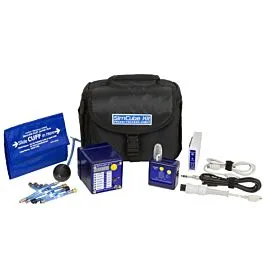
Patient Simulators
Patient Simulators
Patient simulators are electronic test instruments that generate calibrated physiological signals to verify the performance of patient monitoring equipment. Rather than connecting a monitor to a real patient, biomedical equipment technicians use patient simulators to inject known, repeatable waveforms and parameter values — confirming that a monitor accurately reads ECG, SpO2, NIBP, respiration, and temperature within specified tolerances. These instruments are essential for preventive maintenance, post-repair verification, and acceptance testing of monitoring devices in hospitals, clinics, and emergency services.
Multi-parameter patient simulators, such as the Pronk SC-5 series, combine multiple physiological simulation functions in a single portable unit, enabling comprehensive testing of bedside monitors, transport monitors, and central monitoring systems. These devices typically support standard waveform libraries, arrhythmia simulations, and configurable parameter levels to reproduce a wide range of clinical scenarios.
Typical Applications
- Periodic preventive maintenance testing of bedside patient monitors in ICU, operating rooms, and general wards
- Acceptance testing of new patient monitoring equipment prior to clinical deployment
- Post-repair functional verification of ECG, SpO2, NIBP, and temperature monitoring modules
- Training and demonstration of monitoring equipment responses to simulated clinical scenarios
- Emergency medical services: periodic verification of portable defibrillator-monitors in the field
Popular Brands
Pronk Technologies produces the SC-5 and related patient simulator platforms widely used in clinical engineering departments. Fluke Biomedical offers the MPS450 and PS320 multi-parameter patient simulators with broad compatibility for major monitoring equipment brands. Rigel Medical and BC Group also manufacture patient simulators for biomedical testing applications.