
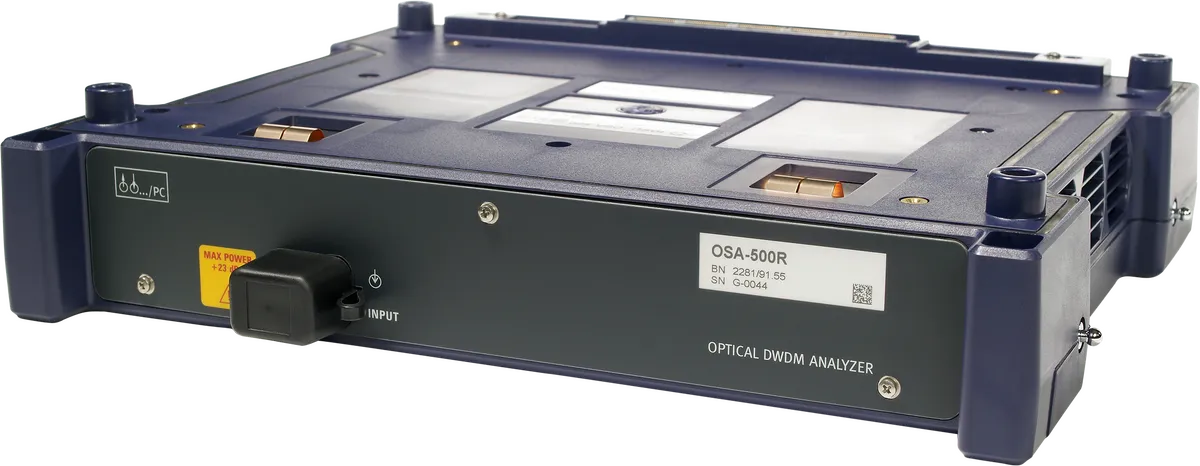
Viavi OSA-500R Optical Spectrum Analyzer
Request a quote
Viavi OSA-500R optical spectrum analyzer for ROADM, DWDM, and CWDM testing with 0.038 nm resolution and true in-band OSNR measurements.
Product details
| Model | OSA-500R (2281/91.55) |
| Manufacturer | Viavi |
| Category | Network & Fiber Optic Test |
| Availability | Made to order |
Description
Overview
Viavi's OSA-500R is a full-range optical spectrum analyzer designed for spectral measurements in CWDM, DWDM, and ROADM systems with datarates up to 100 Gbps. It features VIAVI's proprietary Optical Polarization Splitting (OPS) method for measuring true in-band OSNR in ROADM-based networks, with wavelength coverage from 1250 to 1650 nm. The modular design combines laboratory optical performance with field portability for installation, maintenance, and network upgrade testing.
Key Features
- Optical Polarization Splitting (OPS) method for measuring true in-band OSNR in ROADM-based networks
- Wide tuning range of 1250 to 1650 nm suitable for CWDM, DWDM, and Metro networks up to 100 Gbps
- Channel drop option for single-channel isolation and in-depth signal analysis with BERT or Q-factor measurements
- Software option for PMD testing based on fixed analyzer PMD test method
- Built-in optical component test applications for laser diodes, LEDs, and optical amplifiers
- Internal online wavelength calibration ensures accuracy without requiring recalibration
Applications
- Measurement of true in-band OSNR in Agile Optical networks including ROADM testing and dispersion compensating modules
- DWDM and CWDM system testing during installation, maintenance, and network upgrade
- Automated DWDM passive and active component testing
- System verification testing according to customer preset limits
- Verification of ROADM configurations in Agile Optical Networks
- Full-band optical spectrum analyzer for ONT platform and T-BERD/MTS equipment
Specifications
| Form Factor | Modular |
Request a quote
Viavi OSA-500R Optical Spectrum Analyzer
Response within 24 hours
No obligation
Direct communication